Facebook Badge

Saturday, April 11, 2020

COVID-19 Pandemic, US Economy/Stock Market Prospects and Investment Strategy


Author: Maneesh Nath
Dated: 4th Apr 2020


'In the middle of difficulty lies opportunity'.-Albert Einstein


Due to the COVID-19 Pandemic, US Stock markets, which have been in the longest Bull Run for the last 11 years, starting in 2009 have seen the steepest decline in its entire history and have now entered the bear market territory. Just seven weeks ago, on 12th Feb 2020, Dow Jones Industrial Average (DJIA) reached an all-time high of 29552 and on 23rd March 2020 created a low of 18592, a sudden decline of over 35%. Due to this breakdown in the US economy, GDP is now estimated to decline by 10% in 2020 from the current level of $22 Trillion to 2017 level of ~$20 Trillion, so three years of US economic growth disappeared in few weeks, leaving millions of Americans unemployed, but that doesn’t mean, the US is not going to come out of this crisis, it will come out of it and even stronger. The US Government gets a ~30% share of what the US Inc. produces due to its taxation power and The Federal Reserve is borrowing from the US future and injecting it in the economy now to save the present. They have successfully bridged the gap in the 2008 Credit Crisis led Great Recession and they will be successful in 2020 too.

The speed with which The Federal Reserve with the financial backing from Congress and the US Treasury has intervened this time and got together a $2.3 Trillion stimulus package, a Main Street Business Lending Program authorized by the Coronavirus Aid, Relief and Economic Security (CARES) Act, it is nothing short of spectacular. If they had done nothing but let the entire US economic system collapse, it is like having an advanced medical treatment option available and not providing it to a patient and denying him any chance of survival.

Over the last 25 years, US GDP has grown at 4% from $7.5 Trillion in 1995 to $22 Trillion in Feb 2020. If we use a conservative estimate of half of that growth (i.e. 2%) for the next 40 years, the US GDP has the potential to reach ~ $50 Trillion by 2060. So, this estimate gives FED the confidence to borrow from the future and bridge the gap today. With a Debt/GDP of 150%, US Debt can easily sustain from the current level of $25 Trillion to $75 Trillion by 2050, so the FED balance sheet has additional capacity to borrow over $50 Trillion over the next 40 years before the debt becomes hard to service. With this kind of massive borrowing capacity, the US dollar and US Treasury Bill look like a safe haven to the investors. These are the calculations that the FED has done before going all-in to save the economy. In the distant future, will it be necessary to inflate the debt to those levels? No, but if a crisis occurs, can the FED borrow a few trillion dollars from the future to save the economy which has taken over two centuries to come to this stage, and show bright prospects over the next 40 years, the answer is a clear Yes.


Now let’s see, what the markets looked like 25 years ago in March 1995, S&P 500: 500 (vs. 2750 in 03/2020) So, ~ 6X in 25 years (Annualized Rate of 7%). If we use the past 25 years of Annualized Rate and project it for the next 30 years, the S&P 500 has the potential to reach ~ 20,000 by 2050. So, this is the target which the long-term investors (who are panicking now) should focus on and stay invested.
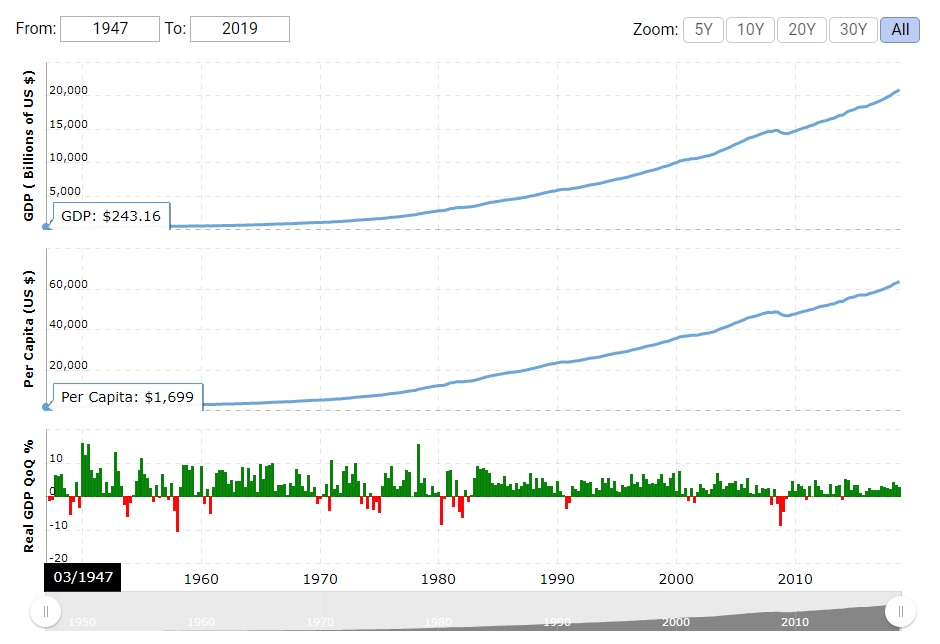


US GDP 25 years ago in March 1995: $7.5 Trillion, 3X in 25 years.
US GDP 50 years ago in March 1970: $1.0 Trillion, 22X in 50 years.
US GDP 100 years ago in March 1920: $84 billion, 260X in 100 years.
US GDP 200 years ago in March 1820: ~$1 billion, 22,000X in 200 years.

The US rose from roughly 1 Billion dollars in GDP two hundred years ago to well over $22 Trillion in 2020, this growth happened due to the meritocratic system and collective efforts of the most enterprising and hardest working people on the planet. Other countries who didn't follow this path, their living standard might not have improved at the same rate as it did for the US. The US from its early days created a system through which they leveraged its resources, got together the best people from around the world in a way to become the superpower in a hundred and fifty years. That first cycle even encouraged more developments and growth due to which the US has reached the unparalleled economic status in the world. Now the US is currently engulfed with several problems like a health crisis, economic crisis, energy crisis all at the same time. Before one gets pessimistic about the US economic prospects, one thing which needs to be kept in mind is that the US has endured several catastrophic events in the past two centuries and has always found a way to come out of it.

People who are pricing the markets as the end of the world scenario or are a debt hawk, don’t realize that the US has prosperity creating a capitalistic ecosystem, rule of law, infrastructure, and meritocracy in place. Due to this fact, most of the best companies in the world today are from the US and possess the cutting edge advanced technology, best education system, healthcare, basically has whatever it takes for a country to become the greatest economy in the world. It didn’t happen by chance, it took over two hundred years of collective wisdom, hard work, planning to fruition to reach the current status.

No country with a significant population has a per capita GDP of $60,000, that’s because the American workers consistently create that output, day in and day out. US citizens are the most prosperous and enjoy the high living standard due to their sheer determination and grit to overcome any obstacle which may come in their way.

In the time of despair, one can be overly skeptical and argue that the US economy is based on high debt and is in bubble territory but one has to treat the US economy as an advanced financial service institution, where the Debt/Equity ratio (Total Debt/GDP) is always high. While valuing a company from any other industry, it is always good to have a Debt/Equity ratio of less than one but for financial services companies, their books are leveraged and under normal circumstances work fine.


During the 2008 credit crisis, FED along with European and major Central Banks around the world implemented Keynesian expansionary monetary policies and stimulated their economy with the Quantitative Easing (QE); the U.S. Dollar Index (DXY) which tracks the strength of the dollar against a basket of major currencies in the world has strengthened by 25% in the past decade. People who are curious about hyperinflation in the US and worry about the purchasing power of the dollar are missing one important factor that the US has stayed as a superpower for around a century now. The US has created the best Institutions in the world, has top-level intellectual capital doing innovation on a large scale. These institutions were not developed in a day; it took several hundred years, increasing the productivity of their workers. The innovation which happened there is the reason why the world is now able to come together on the US social networks in the moment of this crisis together.


The productivity of the US workers has remained on the top over the last seventy years and increased roughly four folds from $18/hour in 1950 to $67/hour in 2017. Due to the social distancing measures, the US economy is going to come to a partial halt in this quarter and then gradually pick up in the second half of 2020 and the US workers will go on to produce what they did earlier. Due to the uncertainty caused by the COVID-19 pandemic, high unemployment numbers, weak earnings reports, 2020 US presidential elections, we should expect a lot of volatility in the stock markets which can easily test the level where it was, say five years ago. At the time of extreme distress, we need to remember the things which are knowable and important, that the US can wither this storm and eventually come out of it.

Due to the expansionary monetary policies, the debt level has now increased but for now, the US can sail through this crisis and will get it to a manageable level in a decade.


To keep things in perspective, the total market capitalization of the U.S. stock market is $27 Trillion (2020). (All U.S. based public companies listed in the New York Stock Exchange, Nasdaq Stock Market and OTCQX U.S. Market.) 

As of 2020 U.S. Nominal GDP: $22 Trillion. 
So, Market Cap to GDP in 2020 is (27/22) = 122%
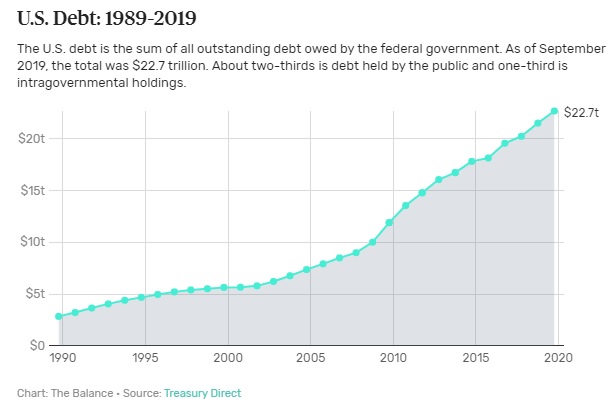


The U.S. Debt is the Sum of all outstanding debt owed by the federal government. At the end of 2020, the total debt will be ~ $28 Trillion. (About two-thirds is debt held by the public and one-third is intra-governmental holdings.)


So, the US Debt to GDP =127% (28/22) will now be in the higher range similar to Japan which like the US is a prosperous nation with a nominal GDP per capita of $41,000 despite an aging population demographic, survived low growth & deflation and now has negative interest rates. In the last twenty years, despite negative macro-economic trends, Japan’s stock market rose though modestly with great companies like Toyota Motor Corporation, SoftBank Group, Mitsubishi UFJ Financial Group, Nippon Telegraph and Telephone, Japan Post Holdings, Sumitomo Mitsui Financial Group, Sony Corporation, Honda Motor Company, etc. producing high-quality products & services rewarding its shareholders well.
Currently, the morale of the people in the US is low, but once this pandemic is over, the economy will also recover as the US has faced difficult conditions in the past and came out of it every time. To put things into perspective, the US with 5% of the world’s population contributes $22 Trillion of the world GDP of $86 Trillion, roughly 25%. Wealth-wise, the US with $106 Trillion, accounts for 30% of the world’s wealth of $360 Trillion in 2020 (China is second with $64 Trillion, Japan is third with $24 Trillion and India is at seventh position with $13 Trillion.) As we can see, China with a GDP of $14 Trillion is now catching up with the US, but where do you think China and India will export their products. Just like Europe & Japan did in the past, China & India will also need access to big markets like the US, so cooperation among the top economies will lead to a win-win situation for the entire world.

Just think, what came out of the 2008 crisis, half-trillion-dollar companies, like Facebook, trillion-dollar companies like Alphabet, Amazon, and even old companies like Microsoft, Apple became a trillion-dollar enterprise, why, because of the ecosystem the US has created in the last century. The US economy works like very large high-performance machinery, sometimes due to a glitch the machine comes to a grinding halt but with troubleshooting, it again goes back in full swing to its full capacity.

The US has an advanced entrepreneurial ecosystem which is the key reason why US entrepreneurs, like Bill Gates, Steve Jobs, Jeff Bezos, Larry Page, Sergey Brin, Mark Zuckerberg to name a few, became so successful. The entrepreneurs who come from outside of the US, like, Elon Musk also owe part of their success to this ecosystem. It would have been hard for Elon to achieve so much in such a short period in any other country. In Dec 2008, both SpaceX and Tesla were facing a serious financial crisis of their own. NASA gave another opportunity to SpaceX and Tesla investors poured in more money in the Electric Vehicles (EV) manufacturer. Since then, SpaceX as a private company has accomplished several successful milestones and Tesla has produced the finest Electric Vehicles which the world needs. To manufacture a car like that, it takes an entire ecosystem to support it, consisting of several business departments, R&D, Design, Engineering & IT, Manufacturing, Sales & Customer Support, Supply Chain, etc. The US has a vast amount of top-level talent pool of designers, engineers, programmers, AI developers, data scientists, business development professionals, etc. This same entrepreneurial ecosystem will give the US the leading edge in the decades ahead to come. Over time, some limelight will be taken away from countries like China and India but the US will be a superpower for the next few decades and till that time, a leveraged economy can function smoothly and the dollar will not lose its reserve currency status.

When the dust settles and the world comes out of this pandemic they will realize this fact and will bring the US markets back to its all-time high levels. Then also, not all US companies will reach its historic highs but the best of the best companies will weather this storm and come out of it with a lot more experience.

People who are talking about Gold and other precious metals as a safe haven need to understand that gold as an asset class has underperformed the US stock market over the last century and it will continue to do so for one basic reason, Gold doesn’t produce anything, its price is based on fear and greed among its investors. Whereas when the top brains come together in an entrepreneurial ecosystem and add value inside a company, for example, Apple, which has its internal ecosystem which promotes innovation that creates hardware, software & services all to work together. So, when Apple comes up with products like the iPhone which consumers all over the world aspire to have, the company’s revenues and profits increase and the company’s stock price rises and their investors are rewarded several times over compared to any other asset class.


For average people, who don’t know how to find companies like Apple at an early stage or are not into equity portfolio management can find a capable fund manager who can allocate it on their behalf. If they are not interested in equities at all, they can look for other asset classes, there is nothing wrong with that, they are just not going to make high returns after adjusting for inflation on their investments compared to equities. So, an averaging out buying strategy or increasing their stakes in the equity portfolio will be a good strategy. Just remember, that if a $22 Trillion economy can have four US companies with trillion-dollar valuation, a $50 Trillion economy by 2060 will be able to support at least 25 US companies with Trillion dollar valuation. So, the right question to ask now is which companies today will reach that level over the next four decades. It is like; someone in 1980, guessing which companies will reach the trillion-dollar valuation by 2020, a very tough problem but can be solved by breaking it into a few stages, decades-long each. So out of the four, only two companies, Microsoft and Apple (50%) were functional in 1980. Taking a cue from this, it is fair to say that out of the 25 potential trillion-dollar valuations US companies, in 2020, 12 companies already exist and 12 companies will be created in this decade. The quest for the investors should be to spot these companies early on and stay invested in them through thick and thin. 

Maneesh Nath
4th April 2020

Email: maneeshnath.devraj@gmail.com, century.partners03@gmail.com


References:
http://www.xinhuanet.com/english/2019-09/27/c_138427756.htm
https://www.thebalance.com/open-market-operations-3306121
https://tradingeconomics.com/united-states/interest-rate
https://seekingalpha.com/article/4324254-u-s-dollar-rises-on-continued-flow-of-safe-haven-money
https://tradingeconomics.com/united-states/currency
https://www.nasdaq.com/articles/the-5-largest-economies-in-the-world-and-their-growth-in-2020-2020-01-22
https://www.barrons.com/articles/global-wealth-grows-2-6-to-us-360-trillion-led-by-u-s-and-china-01571681689

Friday, January 10, 2020

Jan 2020 Update on USA Mid and Large Cap Model Portfolio (created in Jan 2009):


Portfolio Highlights JAN 2020


1. USA Model Portfolio of 17 Mid and Large Cap USA Companies (equally weighted) Out performed the US market for 11 years (Jan 2009 to Jan 2020)

2. USA Model Portfolio went up ~7 folds in the last 11 years (with no turnover) vs 3.5 folds of DJIA

3. Cumulative USA Model Portfolio Returns (over the last 11 years) 570% vs 246% DJIA

4. Annualized USA Model Portfolio Returns (over the last 11 years) 19% vs 12% DJIA;

5. 7%+ Ann. Out performance from the benchmark DJIA

6. Major Performance boosters were: TJX Companies Inc., Ingersoll-Rand PLC, Harris Corporation, Stryker Corporation, FMC Corporation, Varian Medical Systems, Inc.


Disclaimer: Past performance is not an indication of future results. Other disclaimers in regard to investing in equities apply.  

Link to the earlier Post: http://valueinvestornyc.blogspot.com/2012/02/value-oriented-strategy.html


Wednesday, February 15, 2012

Value Oriented Strategy


Buy And Hold Value Oriented Strategy

I am here sharing the performance highlights of my Value Oriented US Companies shortlisted for Institutional Investors and UHNI's on Jan 1st 2009.

Period: All 17 Stocks shortlisted on Jan 1st 2009 and holding for 3 years till Feb 15th 2012

Performance Highlights:-
  • Passive buy and hold policy Outperformed DJIA index during most turbulent times which the global markets has seen in decades.
  • Shortlisting was done for defensive institutional investors who can allocate significant amount of capital and main objective was to keep the downside limited.
  • None of the 17 shortlisted stocks lost money.
  • Value based principles were used to shortlist High Quality Companies with Market Cap more than $1Billion.


Shortlisted US Companies: Jan 1st 2009 to Feb 15th 2012
  1. Piedmont Natural Gas Company, Inc.  
  2. St. Jude Medical, Inc.
  3. Apache Corporation
  4. C.R. Bard, Inc. 
  5. CONSOL Energy Inc.
  6. ConocoPhillips
  7. Chevron Corporation
  8. FMC Corporation
  9. Harris Corporation 
  10. Ingersoll-Rand PLC
  11. MDU Resources Group Inc 
  12. Stryker Corporation
  13. Teva Pharmaceutical Industries Ltd (ADR)
  14. The TJX Companies, Inc.
  15. Varian Medical Systems, Inc.
  16. Exxon Mobil Corporation
  17. DENTSPLY International Inc.

To know more about the companies, write at Century.Partners03@gmail.com

Disclaimer: Past performance is not an indication of future results. Other disclaimers in regard to investing in equities apply.

Wednesday, November 20, 2019


Astral Poly Technik share turned Rs 1 lakh into Rs 13 crore in 10 years

Rs 1,00,000 invested in Astral Poly Technik stock on July 10, 2009 would have grown to Rs 13.27 crore on July 11, 2019.

twitter-logo BusinessToday.In        Last Updated: July 12, 2019  
The Astral Poly Technik share has delivered strong returns for investors during the last ten years. Rs 1,00,000 invested in the stock on July 10, 2009 would have grown to Rs 13.27 crore on July 11, 2019. Astral Poly Technik share price has zoomed from Rs 0.99 on July 10, 2009 to Rs 1,314 on BSE. Astral Poly Technik stock has delivered 1,32,627% returns to its investors in the last 10 years.

Seven of 17 brokerages rate the stock "buy" or 'outperform', five "hold", three "underperform" and two "sell", according to analysts' recommendations tracked by Reuters.

Astral Poly Technik share price has risen 21.93% during the last one year and gained 15.03% since the beginning of this year. In comparison, the benchmark Sensex rose 7.58% since the beginning of this year and gained 6.17% during the last one year. The midcap stock closed at 1,314 level on Thursday. It was trading 0.87% lower at 1,302 level on BSE today.

Financial performance
Astral Poly Technik reported a fall of 4.36% in net profit to Rs 62.47 crore in the quarter ended March 2019 compared with Rs 65.32 crore during the quarter ended March 2018.

Sales rose 21.27% to Rs 774.70 crore in the quarter ended March 2019 compared with Rs 638.82 crore during the previous quarter ended March 2018.

The firm has constantly improved its financial performance during the last 10 years.
For fiscal ended March 2019, the firm logged Rs 2,507 crore in net sales compared to Rs 291.17 crore in sales for fiscal ended March 2010. 

The debt to equity ratio for this plastic products manufacturer during year ended March 2019 stood at 0.13.

For fiscal ended March 2019, the firm logged Rs 200.91 crore in net profit compared to Rs 27.71 crore for fiscal ended March 2010. Price to book value ratio for year ended March 2019 stood at 10.86 compared to 1.86 for the fiscal ended March 2009.

Asset turnover ratio for the year ended March 2019 improved to 119.43% compared to 110.54% for the fiscal ended March 2009. Return on capital employed for the year ended March 2019 stood at 21.09% compared to 17.74% for the fiscal ended March 2009.

What brokerages said
Dolat Capital in a report on May 24 this year gave a buy call to Astral stock with a target price of Rs 1,447.  The current market price at the time of issuing this report was Rs 1,200.  

The brokerage said "Astra has  been  a  multi-year  compounding  story  and  we  expect  the  trend  to continue. The additions in the product portfolio in both  segments -pipe  and adhesive-will   augment   growth, with an expanding   margin   profile.   Astra's management  strategy is to  pursue  profitable  volumes,  which  is  likely  to ensure margin  protection  and  keep the balance sheet strong.

Despite very  high valuations, we believe that Astra stock performance will continue to be driven by profitability growth. We rollover our valuations to FY21E earnings, and reiterate Buy with a target price of Rs 1,447."

After the firm announced its Q4 earnings in last fiscal, IDBI Capital upgraded the stock from Sell to Hold.

IDBI Capital on May 23, 2019 said, "Astral Poly Technik's (Astral) Q4FY19 result was largely in-line to our forecast. Revenue grew by 19% YoY to Rs 770 crore. While EBITDA remained flattish on a YoY basis at Rs 120 crore owing  to  higher  other  expenses, Adjusted   profit after tax declined  13%  YoY  to  Rs 61.1 crore. Plastic segment (Inclusive of Rex) witnessed volume growth of 23% YoY to 38,877mt whereas EBITDA just grew by 9.7% YoY to Rs 977 mn owing to higher expenses.

Further, Adhesive business revenue increased by 19% YoY  to Rs 180 crore while EBITDA declined by 22% YoY to   Rs 25 crore due   to   higher branding   expenses.  We largely   keep   our   estimates unchanged  and introduce  FY21  financials  and  expect  its revenue/EBITDA/PAT  to  see  a compounded annual growth rate of 19%/21%/29% during FY19-21. We raise our target price to Rs 1,255 (PER of 45 times FY21 Estimated) from Rs 945 as we roll over our valuation to FY21E. We upgrade the stock to HOLD from SELL."

ICICI Direct Research in a report on February 13, 2019 said, "Near-term earnings to be impacted by corrective actions taken in Q3FY19; medium-long term earnings visibility remains strong: Factoring in the Q3FY19 numbers and corrective actions, we revise our revenue and profit after tax (PAT) estimates downward by 6.4%/9.4% and 10.7%/12.9% respectively for FY19/FY20. We expect the company to report revenue and PAT compounded annual growth rates of 21% and 30% respectively, over FY18-FY21. Rolling forward to FY21E, we maintain REDUCE on ASTRA with a revised target price of Rs 1,020 (vs Rs 916 earlier), valuing it at 32 times FY21 estimated earnings."
Astral Poly Technik is engaged in the production of plastic products. The company and its subsidiaries are engaged in the business of manufacturing and trading of pipes, fittings and adhesive solutions.

Its product range includes pipe category for plumbing, industrial, drainage, fire protection, agriculture, electrical conduit and ancillary, and adhesive category for construction, maintenance, wood care and automotive. The company has its manufacturing facilities in India and abroad, and sells across the globe.


Tuesday, November 19, 2019

“2019 MSME Achiever’s Award” for International Achievement in the field of Wealth Management


Hyderabad, Nov 14 2019

“2019 MSME Achiever’s Award” Ceremony took place on 14th Nov 2019, National Institute for Micro, Small and Medium Enterprises (NIMSME), Hyderabad, Telangana.

Awards under ten different categories were given by the honorable Union Minister of State for Micro Small and Medium Enterprises (MSME) Mr. Pratap Chandra Sarangi.

Congratulating all the award winners for contributing in their respective fields and helping in increasing country’s GDP, Mr. Sarangi said the award winners were recognized for their innovation further providing solutions to significant challenges and breaking down barriers.

Maneesh Nath, a global stock market investor who hails from Lucknow, India received the prestigious “2019 MSME Achiever’s Award” for International Achievement in the field of Wealth Management. In the past, Maneesh Nath has won several awards including SumZero’s one of the Top 20 best fund management industry professional award in New York, USA.

2019 MSME Award ceremony organised by VMR9 Events was graced by the presence of Mr. Surabhi Bhoom Rao, Mr. Firoz Bhakt Ahmed and Ms. Dalbir Kaur. Event was attended by several distinguished professionals from different industries like Wealth Management, Media, Innovation and Technology, Healthcare, E-commerce, Social, Sports, Art and Craftsman, Agriculture and Tourism.

Speaking at the presentation of the Achievers Award 2019 at the National Institute for MSME here on Thursday, the Minister said the MSME sector is the largest employment generator after agriculture in the country.

Minister lauded the MSME sector and said it will play a crucial role in achieving the Centre's target of making India a $5 trillion economy.


Saturday, June 8, 2013

Endorsement on 2012 Portfolio Performance


Sharing Here Endorsement on 2012 Portfolio Performance

Endorsement!


For more information, kindly write to us, thanks

Tuesday, December 4, 2012

Value Oriented Active Strategy Service

VALUE ORIENTED ACTIVE STRATEGY SERVICE


Indian Equity Portfolio Average Net Return of 45%+ in last 7 Months*. 

Out-Performed Indian Equity Index Benchmark by 30%.


Performance: Our Value Oriented Indian Equity Portfolio using Active Strategy is up by 45%+ during May 2012 to Dec 2012. We have out-performed the benchmark Index during this period by 30%+.

Overview: In the year 2012, we saw several global and local issues affecting market sentiment negatively. Despite all the gloom and doom reports, markets throughout the globe saw light at the end of tunnel and rallied. Warren Buffett has said, there are 3 things to master to do well in investing field. First one is learn how to value a company, second is to know how the market works and thirdly to have an even temperament through thick and thin. Due to our focus on finding high quality undervalued companies, we stick to our investment tenets and what we can find out more about these companies. Only thing which we may look time to time is the overall market P/E, presently around 17 which is moderate. 

Highlights: On May 23rd 2012, we came out with 20 investment ideas and created an equally weighted portfolio. Out of these top 20 companies, some performed very well like PVR, Bannariamman Sugars, Symphony Ltd., Manappuram Finance. One investment idea specifically didn't performed during the next 3 months was Torrent Power. Overall portfolio was up 20%+ in little over 3 months. On Sep 3rd 2012, we came out with total 16 stocks portfolio where 12 new ideas and 4 old ideas from May 23rd were considered. Portfolio was again equally weighted and till Dec 2012 provided returns around 20%+. PVR, Mangalam Cement, Persistent Systems, JB Chemicals & Pharmaceuticals did excellent. Foseco India didn't performed to our expectation.

Overall since May 2012, in less than 7 months, portfolio is up 45%+ out-performing the market by 30%.

Outlook for 2013: Downside risk is limited as we move into 2013 with better earnings forecast, more liquidity in the system and improved market sentiments. Irrespective, we don't worry much about things which are not in our hands, on the contrary there are few things which are in our hands, like to review the companies we invest in on the most stringent valuation criteria, management quality, strength of economic moats to make sure there is not much downside risk, upside is taken care of when the market realizes inherent intrinsic value.


Value Investing is a life long humbling learning process where we try to gain more when we get it right than we lose when we get it wrong.

Happy Investing in 2013!

Century Partners


For more information in this regard, kindly contact us, thanks.


Disclaimers: This summary is for generic information purpose only and express our views and not an offer to buy or sell. 
*Past performance is not a guarantee of future results.

Monday, November 19, 2012

EQUITY RESEARCH REPORT: KOEL


EQUITY RESEARCH REPORT: Kirloskar Oil Engines Limited

NSE: KIRLOSENG; BSE: 533293; ISIN: INE146L01010; 
Reuters: KIRO.NS; Bloomberg Ticker: KOEL:IN

Rating: Buy; Originally Recommended on May 23rd 2012 at Quote: Rs. 152

Equity Research Report


Disclaimer: This Report is for information purpose only and express our views about the company, not an offer to buy or sell. Risks involved in investing is not suitable for all kinds of investors. Seek professional advice if this research is suitable for you.

Saturday, October 20, 2012

Portfolio Valuation Service

Portfolio Valuation Service


We provide customized equity Portfolio Valuation Service (PVS) to Institutional Investors, PMS's, and Brokerage Houses. 

Under this segment, we provide thorough diagnosis on client's portfolio with actionable recommendations. 

We advise big client's on several of their existing customer's portfolio with a detailed analysis of present portfolio health and it's monitoring. 

As per client's requirement, we can add value with our expertise and as per the need evaluate the portfolio on a monthly/quarterly basis. 

Client's benefit by receiving our expert opinion on their existing portfolio's, manage risks along with getting new stocks ideas with good return potential. 

For more information, kindly contact us, thanks

www.centurypartners.in

Tuesday, October 2, 2012

The $10 Trillion Dollar Prize: Captivating the New Affluent in China and India

BCG Executive Summary of The $10 Trillion Prize Link


October 1, 2012 12:24 am

Cashing in on the middle class revolution

Culturally they are poles apart, but as consumer markets, China and India share more similarities than at first appears
The $10 Trillion Dollar Prize: Captivating the New Affluent in China and India, by Michael Silversteen, Abheek Singhi, Carol Liao and David Michael, Harvard Business Review Press, RRP$30
 
It is no secret that Asia’s two emerging superpowers are giving birth to a vast new middle class. But just what is meant by that term is rather less clear. Take India, a nation of about 1.2bn people. Are its middle classes those 5 per cent who live in car-owning households? Or are they the 21 per cent with motorbikes, or those roughly two-thirds who have a mobile phone or access to electricity?

That said, the authors, all of whom work for the Boston Consulting Group, make a convincing case for the importance of this eastward shift in global spending. Their book is engagingly written too – notwithstanding an unfortunate habit of dotting the text with bullet points and management jargon.Such distinctions may be imponderable; Britain and America still can’t quite decide on what it means to be middle class either. But one fact is not in doubt: about 2.5bn Chinese and Indians are becoming wealthier at historically unprecedented rates, and the more prosperous among them are spending more. Much more, in fact: hence what Michael Silverstein and his trio of co-authors call the “$10tn prize”, or total consumption in both countries in a decade or so.
This titular figure is suspiciously neat and relies on assumptions of continued 8 per cent annual growth, which, in India at least, currently looks unlikely. The expansion will not be shared evenly either: China is already much the richer of the two, and its consumption rate will still be roughly double that of its southern neighbour by 2020.
Most pleasing, however, are their many insights into changing customer habits. Some of this involves what the quartet grandly call moving up “the consumption curve”. One example of this is the fact that people tend to spend much more on their skin than their hair as they get richer – a crucial insight for luxury goods companies.
Equally intriguing are the stories of companies that have succeeded in China and India by adapting to local tastes. LG, the electronics group, chanced upon the idea of selling a television with extra loud volume controls and an automatic brightness setting, winning favour from Indians who often watch in noisy family living rooms, or even outside. Their microwaves have regional autocook settings too: rice-based idlis for the south, Bengali fish curry in the east.
This need to tailor products is one of the book’s main arguments, and one the authors use to rebut an obvious criticism: namely that there are such large differences between the two countries that comparing them makes little sense.
It is a fair point. Culturally, the two could hardly be less alike and there are obvious demographic differences as well: Indians have large families; China has a one-child policy. But they are more similar than they at first appear in other ways: India’s economy is smaller, but proportionally more orientated towards consumption, while China has a vast export sector.
More important is the fact that India lags behind its larger neighbour by about a decade, a legacy of its later opening up to globalisation. Yet this makes the comparison more instructive, not less, as is the case with luxury cars. Here China is already the world’s largest market, after an enormous growth spurt in the early 2000s that caught the likes of Audi and BMW flat-footed. But those manufacturers learnt their lesson and are now investing heavily in India, in anticipation of the same take-off occurring there.
Even so, the authors are right to stress that the emergence of a new Indian and Chinese consumption class is a long-term phenomenon that should be understood as part of the broader economic development of each nation, not just a story of companies selling knick-knacks in ever greater numbers.
Air conditioning is a good example. Only 2 per cent of Indians now own a cooling unit despite their nation’s oppressive heat. But few will be able to buy one until their country is able to produce inexpensive, reliable electricity; a trickier problem that it currently shows few signs of solving.
The same is true globally: consumable durables heading off to aspirational Asian homes will significantly increase demand for inputs such as steel and iron ore, pushing up costs for western consumers and putting untold new pressures on the world’s natural resources.
How this journey ends is unclear. Both India and China are poor countries: it will take a generation or two before either comes close to western per capita income and living standards. But their direction is clear enough, as are the aspirations of their peoples. This is a middle class revolution from which very few will emerge untouched.
The writer is Mumbai correspondent for the Financial Times

Value Walk: 8th Annual NY Value Investing Congress 2012: All Speaker Presentations

Value Walk: 8th Annual New York Value Investing Congress 2012

Investment Ideas Presentations from Bill Ackman, Barry Rosenstein, David EinhornAlex Roepers, John Mauldin, Zack Buckley, Mick McGuire’s, Whitney Tilson, Kian Ghazi, Glenn Tongue :-

http://www.valuewalk.com/2012/10/8th-annual-ny-value-investing-congress-2012-all-speaker-presentations/


Monday, September 24, 2012

Ten Companies

Ten Companies We Like On Value Basis:


Disclaimer: This is for information purpose only and express our views, not an offer to buy or sell. Risks involved in investing is not suitable for all kinds of investors. Past performance is no guarantee of future performance. Seek professional advice if this research is suitable for you.

Saturday, August 11, 2012

My Message to Veritas Investment Research Firm


My Message to Veritas Investment Research Firm: 

Don't you see any hope among the Indian Companies and when will you issue a Buy Recommendation to them!

In the last few years, a research firm based out of Canada, Veritas has only come up with scathing reports for Indian companies. They have openly challenged BRICs growth prospects and investment returns by calling it a world's imagination. As per them the riches can be made only in North American region. They have openly disputed the real returns which investor have made by investing in BRICs in the last one decade and more.

Veritas has recklessley provided few poster child examples where as per them everything is questionable. My contention with Veritas is why every company they cover has to be a short idea, can't they find one well run company in BRICs, that they have to paint everything with one same brush. This is not reporting then, it's called biased reporting which is not good for the people who read those reports. Most of the investors and hedge funds make money by both going long and short, so why is this outcry against BRICs in terms of corporate governance. I am sure in the past they must have found enough short candidates in the North America but are they painting everything there with one brush.

Legendary investors like Warren Buffett have invested in PetroChina and made billions of dollars, there are many more examples like that of major institutional investors making ton of money by investing in emerging markets. I think when investors have practically made money and not just coming up with theoritical research reports, entire world knows who is right. Veritas needs to broaden their mindset for emerging countries by digging in further and also start covering companies where the company is world class, stay rest assured, if they know where to look at they will find plenty of them.

Veritas has a genuine concern when they talk about corporate governance, accounting standards and disclosure practices among BRICs. Their financial standards need complete overhaul, there is no question about it but do they need to come up with all the negative side of the emerging countries, what about the positives. Returns made in BRICs specially China and India despite all the issues in the last decade have been outstanding compared to the developed world. Investors too know about this so no matter how much a research firm can trumpet the horns of their advanced knowledge of corporate governance and accounting standards, the fact of the matter is investors need Alpha and there are not many places nowadays where they can find that.

So as long as BRICs keep on providing the extra yield, no amount of malign from research firms like Veritas is going to down play the role of emerging markets in this century. Denying the fact that riches are not going to be made in the emerging markets is in fact denying the truth (Veritas a Roman word meaning Truth).

There is no question as mentioned earlier that sooner the emerging countries adopt world class financial reporting framework the better it is for the country. One point though which one needs to keep in perspective despite any amount of criticism against any emerging economy is that some time earlier even the developed markets have faced these same problems. Despite that when these countries were growing, investors have made real money by investing in the companies of that era. So how-come we are expecting everything to be same from the economies who are in the development stage now. This is not fair to say the least. As far as advanced financial regulations are concerned we all know even with that in place what happened in the last decade with Enron, WorldCom, and so many other developed country companies.

I have written considerably in the past on why economies like China and India are going to deliver better returns despite all the monumental issues which these countries face today. Main reason is the demographics which play a huge role when a country is in growth phase, this has happened through out the history, there is lot of hard evidence to prove the same so why is it going to be different this time. Close to one third of the world population lives in China and India and the largest work force is there so what is coming in the way for them to become the next superpower. China has already shown remarkable growth in the past 3 decades and India is going to continue the same path for decades ahead. Someone telling that corporate governance and financial regulations are going to stop that have no connection with the reality of what is actually happening on the ground level.

Veritas needs to come to emerging countries and then write reports, good or bad but but need to be in touch with the reality before making claims like that the investors investing in BRICs don't know what they are doing. At the end of the day, it is investor's money, if they will not get the returns they will move to a new destination, they are not going to wait for any research firm like Veritas to tell them what they are suppose to do with their money. This is free market, if the investors don't make money, they just leave. 

Veritas needs to do some soul searching and come up with a balanced approach towards covering companies from BRICs and not just give Sell recommendations but come up with some Buy recommendation as well. The past decade data showed investors investing in BRICs made money and making money is what investing is all about. This is not just economies of forecasting but a real money making machine, so invest in emerging markets and be a part of the constructive growth.


Wednesday, August 8, 2012

Coverage on PVR & Astra Microwave Products


In our series of researching under valued and high growth companies, we have now started covering following companies.

1. PVR

BSE: 532689 | NSE: PVR | ISIN: INE191H01014 | SECTOR: MEDIA & ENTERTAINMENT


2. Astra Microwave Products Ltd.
BSE: 532493 | NSE: ASTRAMICRO | ISIN: INE386C01029 | SECTOR: TELECOMMUNICATIONS - EQUIPMENT


Originally recommended on 23rd May 2012

For more information on the companies we are covering and their reports, kindly contact us at century.partners03@gmail.com


Disclaimer: This is for information purpose only and express our views, not an offer to buy or sell.

Sunday, August 5, 2012

Equity Research and Advisory Services


Equity Research and Advisory Services: Based on two decades of Capital Market experience, we provide excellent investment research and analysis reports for global secondary markets. 

We possess valuable equity analysis/valuations/stock picking skills based upon leading global value investors investment principles. 

To know more about our Equity & Research Advisory services where we provide our recommendations for listed companies, kindly email us at century.partners03@gmail.com


Disclaimer: This is for information purpose only and express our views, not an offer to buy or sell.

Monday, June 25, 2012

Century Partners Has Partnered With Rel-Integral Based In India And UK


Century Partners Has Partnered With Rel-Integral Based In India And UK


We take this opportunity to kindly let you know that during May 2012, Century Partners have partnered with Rel-Integral, a Corporate Consultants Private Limited firm based in India and UK.


Century Partners has joined hands with Rel-Integral to provide excellent Equity Advisory and Financial Services to people around the world.


We can collaborate with companies in several ways such as providing them with Financial Services, Legal Services, Regulatory Compliances Tax Advisory Services, Audits and Accounts, Equity Advisory and Risk Management.

  • Rel-Integral with it's highly qualified and experienced team members provides specialized services in corporate and commercial fields.

  • Assist its clients with a full spectrum of services to facilitate growth of business establishments.

  • Builds enduring relationship with its clients based on trust, innovation and by rendering customized and value added corporate practices.

  • Help its clients in taking critical decision making process.

For more information, kindly check our Corporate Profile Presentation.


Contact us via email/phone or visit our offices in all the major cities in India and London, UK.